
Is myopia in kids really increasing?
Yes. Rates of childhood myopia have climbed sharply over the last generation. Researchers point to two big lifestyle shifts: more time on near work and screens, and less time outdoors in daylight. Time spent outside, in particular, appears to be protective for developing eyes. Family history matters too: children whose parents are nearsighted are more likely to become nearsighted themselves. None of this means a parent did anything wrong.
Myopia itself happens when the eye grows a little too long from front to back, so light focuses just in front of the retina and distance vision blurs. That length is called the axial length. Because children's eyes are still growing, both the axial length and the prescription can keep climbing year after year. Our quick guide to axial length explains how it is measured.
What signs should parents watch for?
Kids rarely say their distance vision is blurry. They assume everyone sees the way they do. More often, a parent or teacher notices a pattern:
- Squinting to see the board, the TV, or signs.
- Sitting very close to the TV, or holding a tablet or book close to the face.
- Headaches or tired eyes after school.
- Rubbing their eyes often.
- A teacher mentioning trouble seeing the board.
- A stronger glasses prescription at every visit.
These signs are not a diagnosis, and some children show none of them. That is why a yearly exam matters even when nothing seems wrong. A full eye exam is covered yearly by MSP for children 18 and under.
When should myopia control start?
Myopia control tends to work best when it begins early, soon after nearsightedness is first found, because the fastest changes often happen in younger children. There is no strict cutoff; if your child's prescription is increasing, it is worth an assessment at any age through the teens.
We recommend a first eye exam around age 3, or sooner if anything seems off, then yearly. If your child's glasses have become stronger at recent visits, that is the signal to ask about myopia control rather than only updating the lenses.
What happens at the first assessment visit?
- A comprehensive eye exam. Vision, eye teaming and focusing, and eye health, including OCT retinal imaging at no extra charge. This exam is covered yearly by MSP for children 18 and under.
- Axial-length biometry (eye-length measurement). A quick scan with nothing touching the eye that measures how long the eye is, along with other parts of the eye.
- A risk picture. We combine the prescription and the biometry with your child's age, gender, and ethnicity to estimate how their myopia is likely to progress.
- A plan in plain language. Whether myopia control makes sense now, which options suit your child, what it costs, and how often we will re-measure.
It helps to bring any old glasses or prescriptions, and to know whether parents or siblings are nearsighted.
Questions to ask your optometrist
- Is my child's myopia progressing, and how fast?
- Do you measure axial length, and how does my child's compare with other children their age?
- Which myopia control options suit my child, and why?
- How will we know whether the treatment is working?
- How often will my child be re-measured?
- What does the program cost, and what do MSP and my insurance cover?
- What can we do at home to help?
Outdoor time and screen habits
Time outdoors in daylight is one of the most consistent protective factors in myopia research. It does not have to be organized sport. Walking to school, time at the park, and weekends outside all count.
For screens and close work, simple habits help comfort: regular breaks from close-up tasks, holding devices at a comfortable distance rather than close to the face, and good lighting. Think of these as healthy balance, not a treatment. For a child whose eyes are already lengthening quickly, habits alone are not enough, and that is where myopia control comes in.
How our myopia control program works
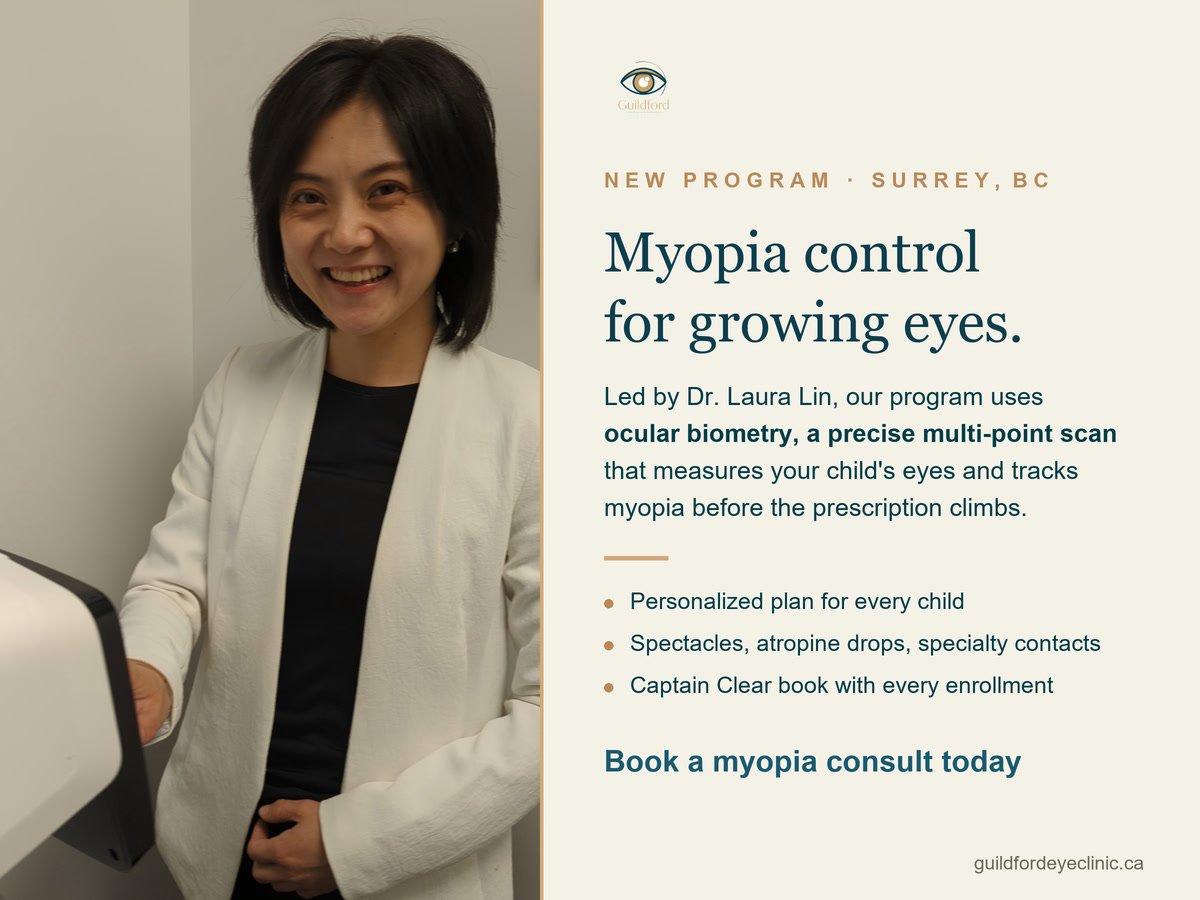
Guildford Eye Clinic runs a kids' myopia control program led by Dr. Laura Lin. It is built on axial-length biometry and uses low-dose atropine eye drops, soft multifocal myopia control contact lenses, and MiyoSmart and Myoeye by Specsavers spectacle lenses, chosen for each child after a full assessment. How each option works, and what the program includes, is on our main page: Myopia control in Surrey. To see how measurement, risk, treatment, and tracking fit together, read The four pillars of myopia management.
The yearly exam is covered by MSP for children 18 and under. The treatment program is separate and not covered by MSP; we direct bill most insurance plans and explain every cost before anything begins. We are inside Specsavers at Guildford Town Centre in Surrey, with easy mall parking.
Parent questions about myopia
Why is myopia increasing in children?
Researchers point mainly to more time on near work and screens and less time outdoors in daylight. Family history also plays a role: children with nearsighted parents are more likely to become nearsighted.
What are the signs of myopia in a child?
Common signs include squinting to see far away, sitting close to the TV or holding devices close, headaches or tired eyes after school, frequent eye rubbing, and a teacher noticing trouble seeing the board. Some children show no signs, so a yearly exam still matters.
Does outdoor time help prevent myopia?
Time outdoors in daylight appears to be protective for developing eyes, and it is one of the most consistent findings in myopia research. It helps, but it does not replace myopia control for a child whose eyes are already lengthening quickly.
What happens at a first myopia assessment in Surrey?
At Guildford Eye Clinic it starts with a comprehensive eye exam, covered yearly by MSP for children 18 and under, plus axial-length biometry to measure eye length. We then explain your child's risk and the options in plain language.
What should I ask at my child's myopia assessment?
Ask whether the myopia is progressing and how fast, whether axial length is measured, which options suit your child and why, how you will know the treatment is working, how often your child will be re-measured, and what it costs.
This article is for general education and is not a substitute for a personalized eye examination. Sources include the International Myopia Institute reports.