
The short answer
Parents ask this on Reddit and in our exam rooms: if my child already has a glasses prescription, why measure the length of the eye too? Because in most nearsighted children the eye is physically growing longer than it should, and that extra length is what pushes the prescription up. Axial length measures the eye itself. The prescription is the symptom; axial length is the structure behind it.
This page is the practical version. For the full reasoning, including a real example from our own clinic, read Why the prescription is not the real measure of myopia.
What is axial length?
Axial length is the distance from the front of the eye to the back. Children's eyes grow as they grow. In myopia, the eye grows longer than it should, so light focuses in front of the retina and distance vision blurs. The longer the eye becomes, the higher the prescription tends to be, and a longer eye is associated with a higher lifetime risk of conditions such as retinal detachment, myopic maculopathy, and glaucoma.
How is it measured?
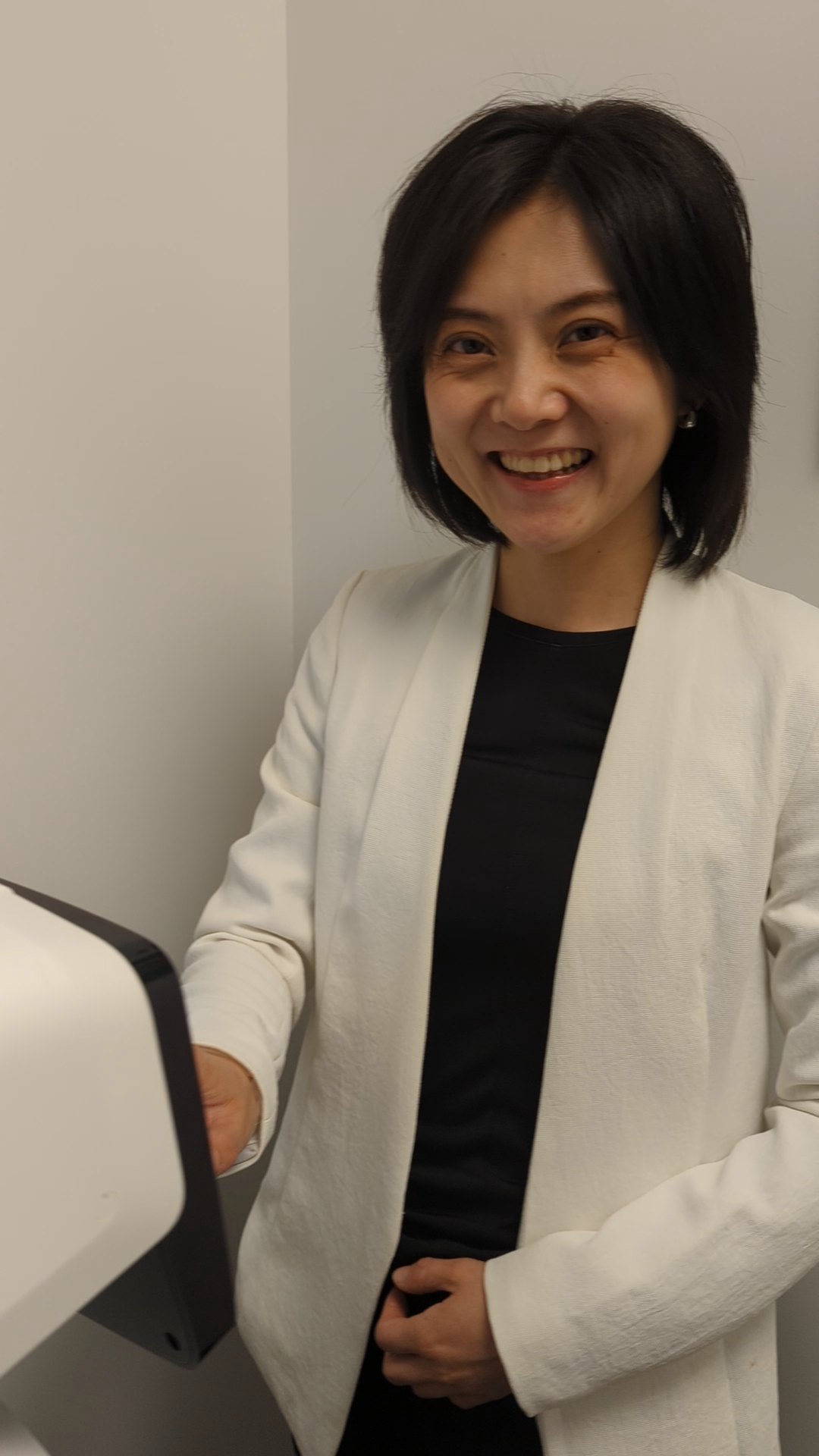
With an optical biometer, a machine that uses light to measure the eye. At Guildford Eye Clinic, axial-length biometry is part of the kids' myopia control program led by Dr. Laura Lin.
Your child sits at the machine, rests their chin on a support, and looks at a small light for a few seconds per eye. In the same scan the biometer also records corneal curvature, corneal thickness, anterior chamber depth, lens thickness, vitreous chamber depth, and pupil size. Together these show how your child's eye is built, not just one number.
Does it hurt?
No. Nothing touches the eye, and the scan takes seconds. The main thing we ask is that your child keeps still and looks at the light. If your child is nervous, let the team know and we will take it slowly.
How often is it repeated?
The first measurement is a baseline, taken at your child's comprehensive eye exam. After that, a single number is not very useful on its own. What matters is the trend over time.
Children in our myopia program are re-measured at regular follow-up visits. Dr. Lin sets the schedule based on your child's age, how quickly their eyes have been changing, and the treatment they are using. Because the scan is quick and painless, it is easy to repeat.
What are the numbers used for?
- A baseline. Where your child's eye length is today.
- A risk picture. We combine the biometry with the prescription and your child's age, gender, and ethnicity to estimate where they sit compared with peers, often shown as a percentile for the risk of developing high myopia.
- Choosing treatment. The measurements help guide which myopia control option is likely to suit your child.
- Checking that treatment is working. Comparing axial length over time shows whether eye growth is slowing, which the prescription alone cannot always tell you.
Those four uses are the backbone of our program, described in The four pillars of myopia management.
Can a normal prescription hide a long eye?
Yes. In young children the lens inside the eye can compensate for a longer eye for a while, so the prescription can look normal while the eye is already longer than expected for their age. The opposite also happens: a prescription can keep changing for reasons other than eye length. Measuring axial length helps tell the two apart. Our in-depth article walks through both situations.
Is axial length measurement covered by MSP?
A full eye exam is covered yearly by MSP for children 18 and under, and that exam is where we take the baseline measurements and decide whether myopia management is right for your child. The ongoing myopia control program, including repeated biometry and treatment, is a separate program and is not covered by MSP. We direct bill most insurance plans and explain all costs before anything begins.
Getting started in Surrey
Start with a children's eye exam at our clinic inside Specsavers Guildford Town Centre. If your child's prescription has gone up at recent visits, mention it when you book. The treatments we offer, and how the program runs, are on our myopia control in Surrey page.
Axial length questions from parents
What is axial length in myopia?
Axial length is the front-to-back length of the eye. In most nearsighted children the eye grows too long, and that extra length drives the glasses prescription up.
How is axial length measured?
With an optical biometer. It is a quick scan where nothing touches the eye: your child looks at a small light for a few seconds per eye while the machine measures eye length and other parts of the eye.
Is the axial length scan painful for kids?
No. It is painless, contact-free, and takes seconds. Your child only needs to keep still and look at the light.
How often should axial length be measured?
The baseline is taken at your child's comprehensive eye exam. Children in our myopia program are then re-measured at regular follow-up visits, on a schedule Dr. Laura Lin sets based on age, how fast the eyes are changing, and the treatment being used.
What are axial length measurements used for?
To set a baseline, to estimate your child's risk of high myopia compared with peers, to help choose a treatment, and to check over time whether the treatment is slowing eye growth.
Is axial length measurement covered by MSP?
The yearly full eye exam for children 18 and under is covered by MSP, and that is where we take the baseline measurements. The ongoing myopia control program, including repeated biometry and treatment, is separate and not covered by MSP. We explain all costs before anything begins.
This article is for general education and is not a substitute for a personalized eye examination. Sources include the International Myopia Institute reports.